
A free guide for leaders
The late arrivals. The 10pm redos. The star employee whose energy shifted. And you keep not saying anything.
None of it is a five-alarm fire. It's the slow stuff: the lateness you let go, the work it's easier to just redo yourself, the check-in you keep meaning to have. So you manage around it and tell yourself you'll deal with it later.
Here's the problem: Later is usually a resignation, a blown deadline, or a great team member who already checked out.
That's what this free guide is for: the 5 conversations leaders avoid most, what's really going on underneath each one, and the exactly what to say to handle it.
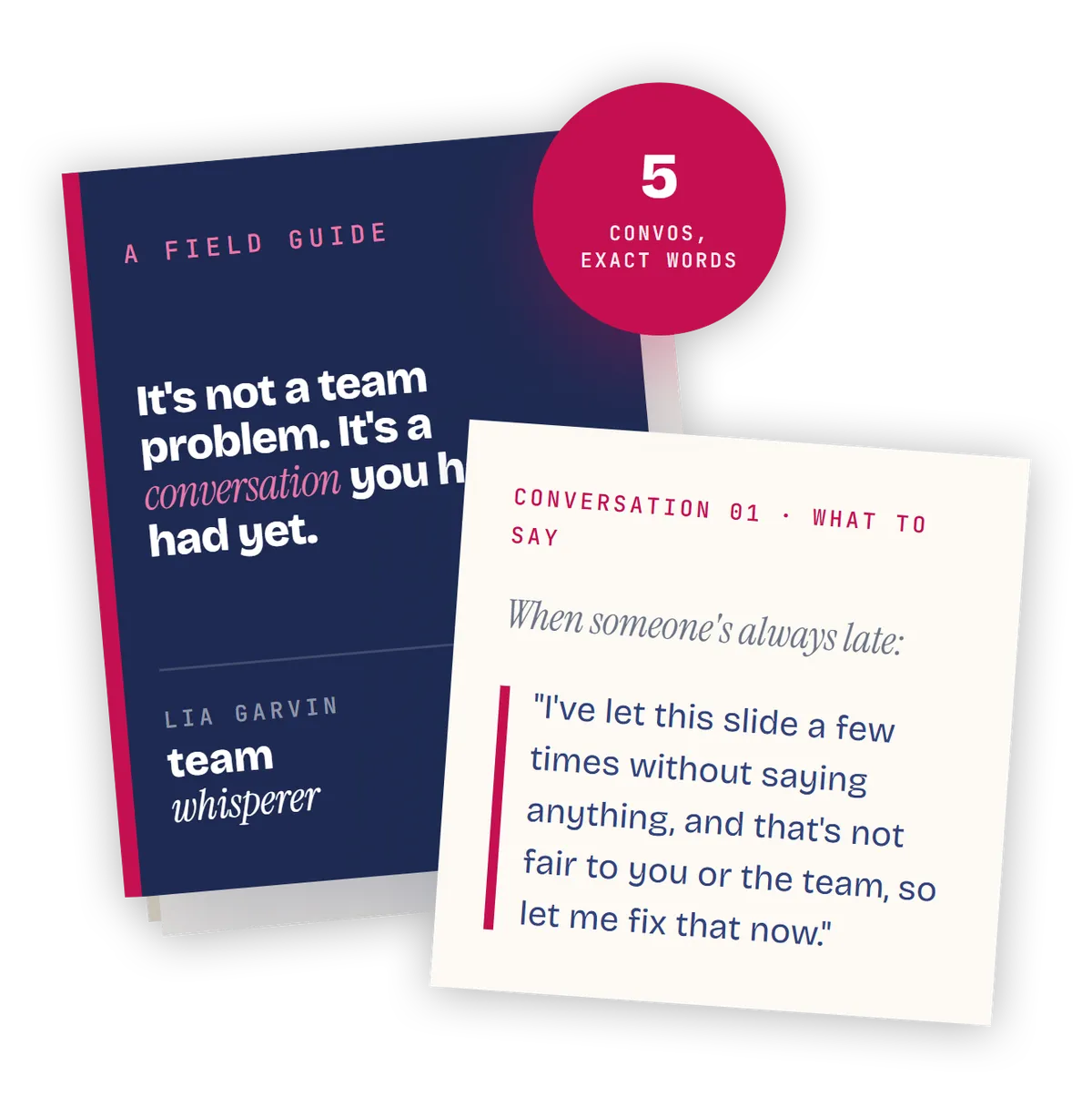
No more typing and deleting variations of the same message five times.
No more waiting for it to get "bad enough" to finally be worth saying something.
No more finding out a great team member leaving when it's already too late.
Lia brings proven strategies from leading teams at




What's inside
Five conversations you keep not having.
01
"Someone keeps showing up late, and I keep not saying anything."
The lateness stopped being about the lateness a while ago. Say it without making it a thing.
02
"They keep doing it wrong, so I just fix it myself."
Redoing the work feels efficient. It's the most expensive feedback there is. Here's the step you skipped.
03
"Someone asks what my team is working on, and I realize I don't know."
Not a trust problem, not a you problem. A visibility problem, with a two-minute fix.
04
"My best person has seemed off, but the work's still getting done."
It should never be a surprise when your best person leaves. Say it before they hand you a notice.
05
"My best people know they're great. I don't need to make a thing of it."
They're sitting with that one-line "great job" wondering if this is as far as it goes.
The simple three-step way to run any of them and the EXACT script to say.
What makes it different
One conversation. Three simple steps.
You don't need to get tougher, or memorize a hundred techniques. You need a simple way to open the conversation you've been avoiding, and the exact words to carry it through. That's the whole guide.
This is not generic communication training you'll forget by Monday.
This is not a 200-page book you'll mean to read and never open.
This is not about being tougher, or more blunt, or "more of a leader."
For you
Walk into the conversation you've been dreading already knowing your first sentence. No more rehearsing it in the shower.
For your team
They hear it as care, not an attack, because you open by owning your part first. Fewer surprises, more trust.
Why it sticks
It's one simple structure, not five scripts to memorize. Learn it once and use it on any conversation, hard or happy.
This is for you if
Sound familiar?
You've decided to "say something" about the same thing three times now, and you still haven't.
You're worried your best person is halfway out the door, but the work looks fine, so you say nothing.
You tell your top performer "great job" and quietly worry it isn't enough to keep them.
You keep redoing your team's work yourself because it's faster than explaining what you wanted.
You dread the conversation going sideways: the defensiveness, the awkward silence, the tears.
You want to lead with more confidence, without becoming someone your team walks on eggshells around.
Why I built this
Like you, I used to dread these conversations too.
Managing former peers, wanting to be the manager people liked, hiring people that I had to ramp up quickly - each of these situations made it hard to say something when I saw an issue start to surface. So I stayed quiet, redoing work on my own, letting things go too long, or not realizing the importance of recognition. Until I was drowning in work and lost one of my best team members. That's when I realized the cost of not saying anything is HIGHER than if you speak up.
This guide is has words I wish someone had handed me on day one.
Here's exactly what you get. Free.
A simple guide, not a lecture.
01
Five word-for-word scripts
The exact opening line for each conversation, ready to use on the one you've been dodging this week.
02
What's really going on underneath
Why each one feels hard, and the reframe that takes the dread out of it before you say a word.
03
The simple three-step structure
One repeatable way to run any conversation, hard or happy. You're not learning five scripts. You're learning one.
04
The line that keeps it from going sideways
The single move that takes the bracing-for-impact out of the room, and the one almost everyone skips.
The shift
From dreading it, to handling it.
You go from
Rehearsing it for weeks
and still never saying the thing
Rehearsing it for weeks
and still never saying the thing
Rehearsing it for weeks
and still never saying the thing
To
Knowing your first sentence
before you walk in the room
Handing it off cleanly
so the work stops boomeranging back
Catching the shift early
while there's still a conversation to have
What leaders say
Working with Lia has fundamentally changed the way I lead my company. This year, she helped me reset our culture from the inside out, guiding both me and my team through meaningful shifts that strengthened our standards, clarified our values, and aligned everyone around a shared mission.
Beth Helmstetter
CEO, BETH HELMSTETTER EVENTS
Get the guide
Leading people is hard enough. Knowing what to say shouldn't be the hard part.


© 2026 Lia Garvin Consulting LLC
Privacy Policy · Terms